Consulting > Consulting Approach

Consulting Approach

1. Risks of the Lodging Business

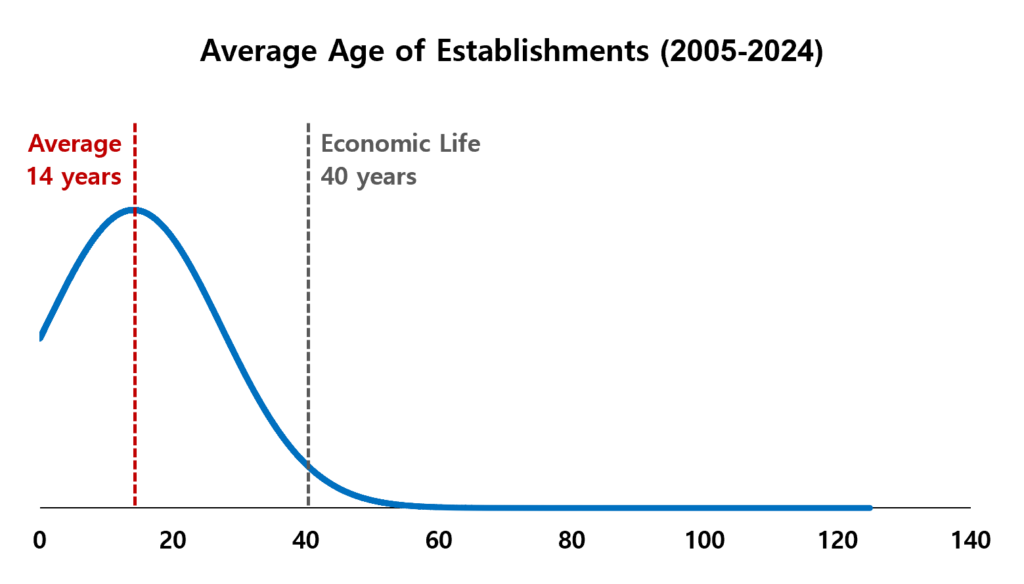
The risk of the lodging business in Korea can be described from its short lifespan. The lodging business is based on assets with an economic life of up to 40 years, and a short lifespan indicates that the asset has not been utilized effectively.

During 2005–2024, the average lifespan of the lodging business in Korea was 14 years, which is only 35% of its economic life. In other words, any investment or lending to the lodging business must be redeemable in 14 years, and the asset must be capable of alternative use thereafter.

2. Risk Management in the Lodging Business

① Maintaining Product Competitiveness

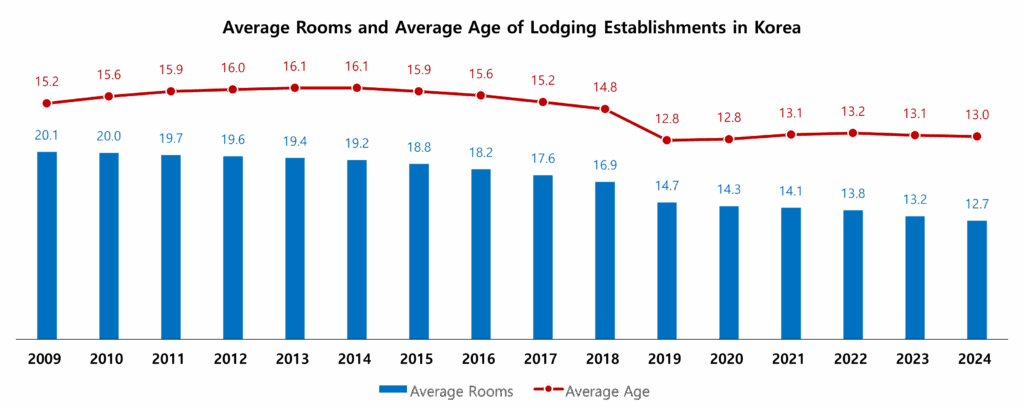
The average room count per lodging establishment in Korea declined from 20.1 rooms in 2009 to 12.7 rooms in 2024, representing an average annual decrease of 3.0%. Over the same period, the average age decreased from 15.2 years in 2009 to 13.0 years in 2024, an average annual decline of 1.0%. In other words, lodging establishments have become increasingly small-scale, while their lifespans have shortened.

* Data Source: Lobin Database (2025-04-15 Update)

Because small-scale lodging establishments inevitably have limitation in product mix, they face constraints in absorbing variety of lodging demand, whether short-term or long-term, individual or family-based. This represents a clear weakness in responding to dynamic market changes.

Rather than encouraging small-scale lodging establishments with limited product mix to pursue excessive investment to expand their size, Lobin Co. guides them to diversify demand through flexible operations. Through the Lobin database, the composition and characteristics of demand by lodging market are precisely identified.

② Maintaining Operational Stability

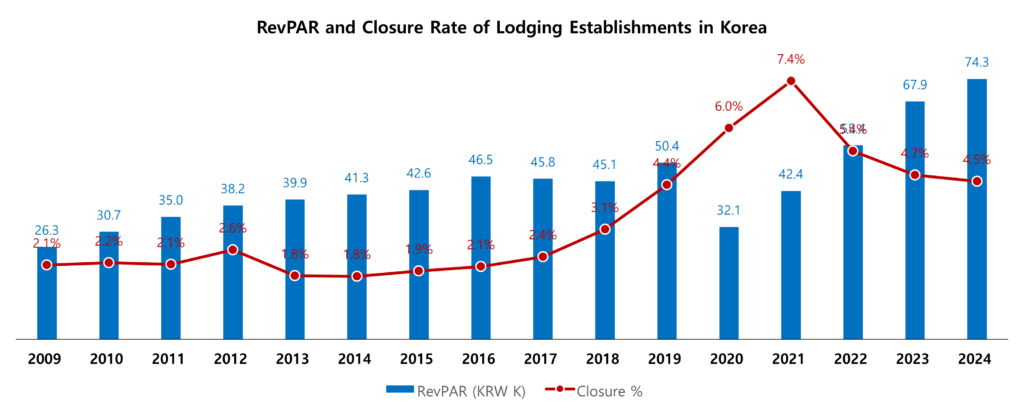
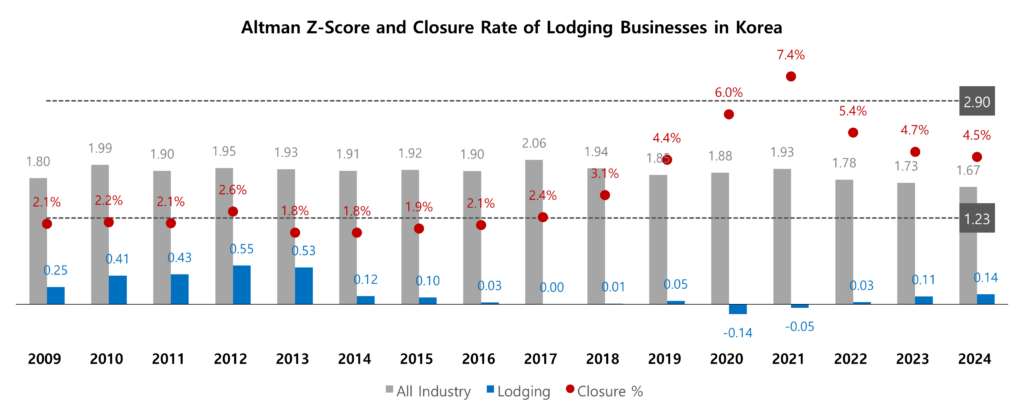
After the enforcement of the Tourist Accommodation Facilities Act in 2012, supply began to increase from 2015 onward, and the closure rate of lodging establishments in Korea started to rise. In 2019, when small-scale lodging establishments surged, closure rates accelerated upward further. The closure rate is still at a high level, which peaked in 2021 due to the impact of COVID-19.

* Data Source: Lobin Database (2025-04-15 Update)

In an increasingly uncertain market environment, fluctuations in revenue are amplified in the lodging business. In particular, for small-scale lodging establishments that are more vulnerable to revenue volatility, maintaining appropriate levels of cost flexibility and financial soundness is critically important.

Lobin Co. secures cost elasticity that enables effective responses not only during market upturns but also during downturns by optimizing the composition of fixed and variable costs. Furthermore, cost flexibility is monitored regularly to ensure its sustainability.

③ Maintaining Financial Soundness

The Altman Z-Score is an indicator used to measure a company’s bankruptcy risk and is one of the core algorithms utilized by credit rating agencies. In the service sector, a Z-Score below 1.23 is considered indicative of high bankruptcy risk. The bankruptcy risk of the lodging business in Korea is therefore very high.

* Data Source: Financial Statements Analysis (BOK, KOSIS), Lobin Database (2025-04-15 Update)

For service industries such as the lodging business, the Altman Z-Score is calculated based on liquidity, cumulative profitability, productivity, and financial structure. A smaller asset size and stronger cash liquidity tend to increase the Z-Score. In such cases, financing from financial institutions may become relatively smoother.

Lobin Co. derives a financial structure minimizing asset burden while maximizing cash liquidity, and optimizes it according to the conditions of each operator. In addition, financial soundness is monitored regularly to ensure its sustainability.

Scroll to Top
Step 1 of 2

Access Request for Data Dashboard 2024

Data Dashboard 2024 provides detailed data for 17 metro markets by establishment type, visualized through Microsoft Power BI.

※ You can use Data Dashboard without extra charges before expiration of the existing access period, if 2025 data is updated during the access period.

Data Source

  • GDP: GDP, Current $US (World Bank Open Data)
  • Establishments: Compendium of Tourism Statistics (UNWTO), Lodging Business Ledger (MOIS)
  • Rooms: Compendium of Tourism Statistics (UNWTO), Lodging Business Ledger (MOIS)
  • Lodging GDP: Value Added by Industry (BEA), National Accounts (Cabinet Office), GDP of Indonesia (BPS), GDP & GNI by Sector (BOK), Economic Census (KOSIS)
  • Period: 2017-2021

※ In Korea, general & residential accommodations are included while rural & urban minbaks are excluded. Comparable countries are selected based upon availability of lodging GDP statistics for all types of accommodations.

Data Source

  • Population: Population, Total (World Bank Open Data)
  • GDP: GDP, Current $US (World Bank Open Data)
  • Rooms: Compendium of Tourism Statistics (UNWTO), Lodging Business Ledger (MOIS)
  • Lodging GDP: Value Added by Industry (BEA), National Accounts (Cabinet Office), GDP of Indonesia (BPS), GDP & GNI by Sector (BOK), Economic Census (KOSIS)
  • Period: 2017-2021

※ In Korea, general & residential accommodations are included while rural & urban minbaks are excluded. Comparable countries are selected based upon availability of lodging GDP statistics for all types of accommodations.

Coming soon! We're still in process.

1:1 Contact

※ Messages intended for defamation or obstruction of business by Lobin Co. and /or other third parties, or containing content that is obscene, violent or unrelated to Lobin Co.’s business, will automatically be blocked by the system and not delivered to the administrator.

Data Source

  • Korea: Lodging Business Ledger (MOIS), Tourist Accommodation Ledger (MCST)
  • USA: Census Database (STR)
  • Period: As at the end of 2021

※ General & residential accommodations other than rural and urban minbaks asre included for Korea. Life cycle was calculated as of December 31, 2021 or actual closure date. If there exists a discrepancy between data sources for an establishment, the discrepancy was settled through an algorithm before use.

Data Source

  • Korea: Lodging Business Ledger (MOIS), Tourist Accommodation Ledger (MCST), Economic Census (KOSIS), Hotel Operating Statistics (KHA), DART (FSS), Trends Report (STR)
  • USA: Compendium of Tourism Statistics (UNWTO), Census Database (STR), Trends Report (STR)
  • Period: 2005-2021

※ General & residential accommodations other than rural and urban minbaks asre included for Korea. Visibility was calculated as the number of establishments for which revenue data is available divided by the total number of establishments. If there exists a discrepancy between data sources for an establishment, the discrepancy was settled through an algorithm before use.

Data Source

  • Guests(Korea): Domestic Traveler Survey (MCST), International Traveler Survey (MCST), Hotel Operating Statistics (KHA)
  • Rooms(Korea): Lodging Business Ledger (MOIS), Tourist Accommodation Ledger (MCST)
  • Guests(USA): Compendium of Tourism Statistics (UNWTO), Trends Report (STR)
  • Rooms(USA): Compendium of Tourism Statistics (UNWTO), Census Database (STR)
  • Period: 2005-2020

※ General & residential accommodations other than rural and urban minbaks asre included for Korea. If there exists a discrepancy between data sources for an establishment, the discrepancy was settled through an algorithm before use.