
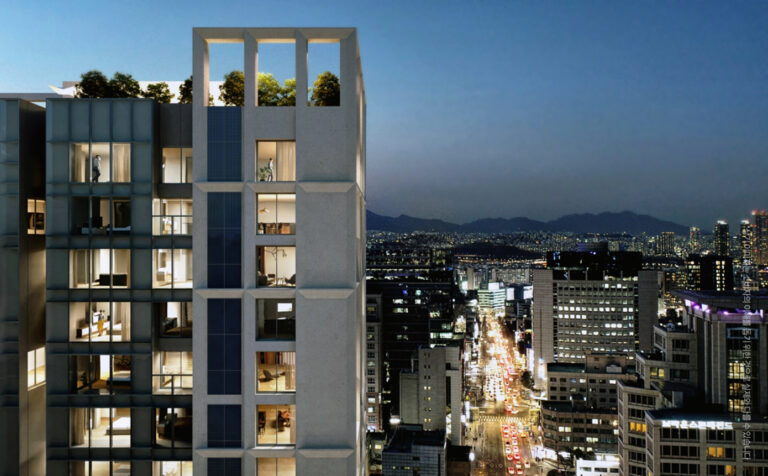
Officetel

An officetel is a portmanteau of office and hotel. It refers to a type of building primarily used for business activities during the daytime, while individual units are designed to allow limited lodging and dining in the evening, creating a hotel-like residential atmosphere. Under the Building Act, officetels are classified as office facilities, whereas under the Housing Act, they are categorized as quasi-housing, which allows them to be used or leased for residential purposes as well.
Dictionary Definition
An officetel is a portmanteau of office and hotel, referring to a type of building designed primarily for business use during the daytime, while providing space within individual units that allows limited lodging and dining in the evening, thereby creating a hotel-like atmosphere. An officetel is a building whose principal use is as an office facility, with business space accounting for 50% or more of the total area and residential space accounting for less than 50%. Under the applicable laws, when an officetel is used for business purposes pursuant to the Act on the Sale of Buildings, taxes are levied based on its classification as an office facility. However, if an officetel is used for residential purposes rather than business purposes, it may become subject to the Comprehensive Real Estate Holding Tax. Furthermore, if the owner holds another residential property in addition to the officetel, the owner may be deemed a multiple-home owner, and capital gains tax may be imposed at a higher rate upon disposition.
Statutory Definition
An officetel refers to a building that is used primarily for business purposes and is designed so that lodging and dining are possible in some of the subdivided units that are sold or leased, provided that it complies with the standards publicly notified by the Minister of Land, Infrastructure and Transport.
Lobin Commentary

An officetel is one of the subcategories of office facilities under the Building Act. Annex Table 1 of the Enforcement Decree of the Building Act classifies office facilities into public office facilities and general office facilities, and officetels fall under general office facilities. The definition of an officetel is as follows:

Officetel: A building that is used primarily for business purposes and is designed so that lodging and meals are possible in some of the subdivided units that are sold or leased, and that complies with the standards prescribed and publicly notified by the Minister of Land, Infrastructure and Transport.

The officetel building standards publicly notified by the Minister of Land, Infrastructure and Transport set forth the following requirements for officetels:

  1. An officetel must have a structure that meets each of the following requirements:
    • When an officetel is constructed as part of a mixed-use building (excluding buildings with a total gross floor area of 3,000 square meters or less above ground), a dedicated entrance exclusively for the officetel must be installed. However, when an officetel is constructed together with a single-family house or multi-family housing, the building owner may choose not to install a dedicated entrance, taking residential functions into consideration.
    • The method for calculating the exclusive use area shall be based on the area measured along the inner line of the exterior walls of the building. From this area, common areas jointly used by two or more units that fall under any of the following items shall be excluded. Any remaining exterior wall area after subtracting the exclusive use area from the floor area shall be added to the common area:
      • Common areas located on above-ground floors of the officetel, such as corridors, staircases, and entrance halls
      • Other common areas, including basements and management offices, excluding the common areas listed in item above
    • Facilities that support the daily living of officetel residents, such as senior centers and daycare centers, may be installed as ancillary facilities within an officetel.
  2. For residential lodging properties for which an initial application for building approval was submitted on or before October 16, 2024 (including cases where an application for review was submitted to the Building Committee pursuant to Article 4 of the Building Act for the purpose of applying for building approval), when approval or notification items are changed to convert the use to an officetel pursuant to Article 16(1) of the Building Act, or when the use is converted to an officetel pursuant to Article 19(2) of the same Act, the requirements under items 2 and 4 of paragraph (1) may be exempted. In such cases, this fact must be recorded in the “Other Matters” section of the building register in accordance with Article 7 of the Rules on the Recording and Management of the Building Register.
  3. In addition, officetels must comply with the following requirements to ensure evacuation in the event of fire or similar emergencies:
    • For officetels of 16 stories or more in which the main structural components are of fire-resistant construction or non-combustible materials, for floors at or above the 16th floor, direct staircases leading from non-evacuation floors to an evacuation floor or to the ground must be installed so that the walking distance from any part of the living space to the staircase does not exceed 40 meters.
    • The boundary walls between individual office units must be of fire-resistant construction and must either meet or exceed the wall thickness prescribed in Article 19(2) of the Rules on Standards for Evacuation and Fire-Protection Structures of Buildings, or secure sound insulation performance of at least 45 dB.

Meanwhile, under the Housing Act, dormitories, multi-living facilities, elderly welfare housing, and officetels are separately classified as quasi-housing. The Housing Act also includes single-family houses, multi-family housing, and quasi-housing within the scope of private rental housing. Accordingly, officetels classified as quasi-housing may be registered and operated as a residential building rental business, even though they are classified as business facilities under the Building Act.
Related Terms
Scroll to Top
Step 1 of 2

Access Request for Data Dashboard 2024

Data Dashboard 2024 provides detailed data for 17 metro markets by establishment type, visualized through Microsoft Power BI.

※ You can use Data Dashboard without extra charges before expiration of the existing access period, if 2025 data is updated during the access period.

Data Source

  • GDP: GDP, Current $US (World Bank Open Data)
  • Establishments: Compendium of Tourism Statistics (UNWTO), Lodging Business Ledger (MOIS)
  • Rooms: Compendium of Tourism Statistics (UNWTO), Lodging Business Ledger (MOIS)
  • Lodging GDP: Value Added by Industry (BEA), National Accounts (Cabinet Office), GDP of Indonesia (BPS), GDP & GNI by Sector (BOK), Economic Census (KOSIS)
  • Period: 2017-2021

※ In Korea, general & residential accommodations are included while rural & urban minbaks are excluded. Comparable countries are selected based upon availability of lodging GDP statistics for all types of accommodations.

Data Source

  • Population: Population, Total (World Bank Open Data)
  • GDP: GDP, Current $US (World Bank Open Data)
  • Rooms: Compendium of Tourism Statistics (UNWTO), Lodging Business Ledger (MOIS)
  • Lodging GDP: Value Added by Industry (BEA), National Accounts (Cabinet Office), GDP of Indonesia (BPS), GDP & GNI by Sector (BOK), Economic Census (KOSIS)
  • Period: 2017-2021

※ In Korea, general & residential accommodations are included while rural & urban minbaks are excluded. Comparable countries are selected based upon availability of lodging GDP statistics for all types of accommodations.

Coming soon! We're still in process.

1:1 Contact

※ Messages intended for defamation or obstruction of business by Lobin Co. and /or other third parties, or containing content that is obscene, violent or unrelated to Lobin Co.’s business, will automatically be blocked by the system and not delivered to the administrator.

Data Source

  • Korea: Lodging Business Ledger (MOIS), Tourist Accommodation Ledger (MCST)
  • USA: Census Database (STR)
  • Period: As at the end of 2021

※ General & residential accommodations other than rural and urban minbaks asre included for Korea. Life cycle was calculated as of December 31, 2021 or actual closure date. If there exists a discrepancy between data sources for an establishment, the discrepancy was settled through an algorithm before use.

Data Source

  • Korea: Lodging Business Ledger (MOIS), Tourist Accommodation Ledger (MCST), Economic Census (KOSIS), Hotel Operating Statistics (KHA), DART (FSS), Trends Report (STR)
  • USA: Compendium of Tourism Statistics (UNWTO), Census Database (STR), Trends Report (STR)
  • Period: 2005-2021

※ General & residential accommodations other than rural and urban minbaks asre included for Korea. Visibility was calculated as the number of establishments for which revenue data is available divided by the total number of establishments. If there exists a discrepancy between data sources for an establishment, the discrepancy was settled through an algorithm before use.

Data Source

  • Guests(Korea): Domestic Traveler Survey (MCST), International Traveler Survey (MCST), Hotel Operating Statistics (KHA)
  • Rooms(Korea): Lodging Business Ledger (MOIS), Tourist Accommodation Ledger (MCST)
  • Guests(USA): Compendium of Tourism Statistics (UNWTO), Trends Report (STR)
  • Rooms(USA): Compendium of Tourism Statistics (UNWTO), Census Database (STR)
  • Period: 2005-2020

※ General & residential accommodations other than rural and urban minbaks asre included for Korea. If there exists a discrepancy between data sources for an establishment, the discrepancy was settled through an algorithm before use.