
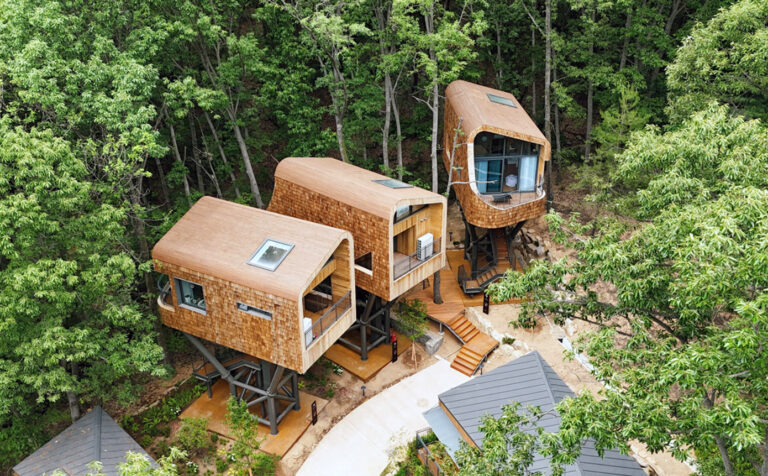
Lodging facilities within natural recreation forests are not independent lodging businesses, but ancillary facilities of the natural recreation forest. Operators run them together with the natural recreation forest under the Forestry Culture and Recreation Act without separate lodging permits, registrations, or filings. The competent supervising authority is the Ministry of Agriculture, Food and Rural Affairs.
Natural recreation forests are designated by the head of the Korea Forest Service. For national forests, designation may be made directly; for shared or private forests, designation is made upon the owner’s application For shared or private forests, the applicant must have secured rights to use the relevant forest.
Operating a natural recreation forest is not classified as “lodging” under KSIC; rather, it falls under “natural park operation” within botanical garden, zoo, and natural park operations. Meanwhile, forest resorts may be registered as “Specialty Resort Businesses” under “Tourist Convenience Facility Businesses” pursuant to the Tourism Promotion Act, provided that the relevant requirements are met.
A Tourist Convenience Facility Business refers to a business that provides facilities suitable for food services, sports, entertainment, recreation, culture, arts, or leisure for tourists and allows tourists to use such facilities. Among these, a Specialized Recreation Business refers to a business that, for the purpose of tourists’ recreation or leisure activities, is equipped with lodging facilities (including rural minbak and facilities installed in natural recreation forests) or restaurant facilities (snack bars, general restaurants, or bakeries), and with one type of specialty resort facility—such as a folk village, beach, hunting ground, zoo, botanical garden, aquarium, hot spring, cave resource, swimming pool, tourist farm, gliding site, sports facility, forest recreation facility, museum, or art museum—and allows tourists to use such facilities.
Annex Table 1 of the Enforcement Decree of the Tourism Promotion Act prescribes the registration criteria for forest resorts as specialty resort facilities as follows.
- Lodging facilities or restaurant facilities must be provided.
- Convenience facilities such as parking facilities, water supply facilities, public restrooms, and rest facilities must be provided.
- Forest Resorts: Facilities that are equipped with a healing forest, natural recreation forest pursuant to the Forestry Culture and Recreation Act, or an arboretum pursuant to the Act on the Creation and Furtherance of Arboretums and Gardens.
The Forestry Culture and Recreation Act defines a natural recreation forest as “a forest developed for the purpose of enhancing public emotional well-being, health and recreation, and forest education (including recreational facilities and the land on which they are located),” and prescribes the installation standards as follows.
- Lodging Property
- There shall be no risk of landslides, etc.
- Facilities shall be placed in areas with ample sunlight, and arranged so that external views are possible
- Convenience Facilities
- Snack bar businesses or general restaurant businesses pursuant to the Enforcement Decree of the Food Sanitation Act shall each be limited to no more than one establishment.
- Campsites and auto-campsites shall be installed in safe areas with good natural drainage and no risk of landslides or similar hazards.
- Sanitary Facilities
- They shall be installed to ensure comfort and convenience.
- They shall be installed so as not to cause forest pollution.
- Drinking water shall meet the drinking water quality standards.
- Outdoor restrooms shall include restrooms for persons with disabilities.
- Experience and Education Facilities
- Forest trails such as walking paths, exploration trails, and hiking trails shall have a width of no more than 1.5 meters (this limit may be exceeded where unavoidable for safety or evacuation purposes), and shall be installed in a manner that minimizes alteration of forest land, taking into account accessibility, safety, and impacts on the forest.
- Nature observation areas shall be established in forests suitable for nature exploration and learning, allowing observation of a variety of tree species.
- Forest training facilities shall be equipped with classrooms, lodging facilities, and plazas, and shall be of a size capable of accommodating at least 100 persons simultaneously per session.
- Forestry experience facilities shall be installed in gently sloped areas and equipped with basic equipment necessary for experiential activities.
- Safety Facilities
- Broadcasting facilities shall be provided to promptly notify users in the event of emergencies, disasters, or safety accidents.
- Lodging facilities shall be equipped with fire-extinguishing equipment (such as fire extinguishers and simplified sprinkler systems), alarm equipment (including gas leak detectors where gas facilities are used), and evacuation equipment (evacuation devices pursuant to Item 3(a) of Attached Table 1 of the Enforcement Decree of the Act on the Installation, Maintenance, and Safety Control of Fire-Fighting Facilities).
- Separate emergency evacuation facilities stocked with emergency supplies such as first-aid kits shall be designated.
- For user safety, safety facilities such as closed-circuit television (CCTV) systems shall be installed, and instructions for facility use, precautions, and emergency evacuation routes shall be posted in clearly visible locations.
The Forestry Culture and Recreation Act defines a healing forest as “a forest developed to enable forest therapy (including facilities and the land on which they are located),” and prescribes the installation standards as follows:
- Forest Therapy Facilities
- Facilities shall be designed to utilize various elements of the forest such as scent, scenery, light, wind, and sound. Buildings shall be constructed at low height and low density using natural materials such as soil and wood, and exercise facilities shall be installed with consideration given to accessibility and safety.
- Healing forest trails shall have a width of no more than 1.5 meters (this limit may be exceeded where unavoidable for safety or evacuation purposes), and shall be installed so as to minimize alteration of forest land, taking into account accessibility, safety, and impacts on the forest.
- Convenience Facilities
- They shall be installed in gently sloped forest areas in harmony with the surrounding landscape.
- Visitor centers shall be equipped with facilities for information provision, promotion, and consultation.
- Snack bar businesses and general restaurant businesses pursuant to the Enforcement Decree of the Food Sanitation Act shall be installed in a manner suitable for implementing dietary therapy.
- Sanitary Facilities
- They shall be installed to ensure comfort and convenience and to prevent forest pollution.
- Drinking water shall meet the drinking water quality standards.
- Outdoor restrooms shall include restrooms for persons with disabilities.
The Act on the Creation and Furtherance of Arboretums and Gardens defines an arboretum as “a facility that collects, propagates, conserves, manages, and exhibits forest genetic resources centered on trees, and conducts academic and industrial research for the utilization of such resources,” and prescribes the installation standards as follows:
- Propagation and Cultivation Facilities
- National and public arboretums: a nursery of at least 300 square meters equipped with irrigation facilities, and a propagation greenhouse of at least 100 square meters.
- Private and school arboretums: a nursery of at least 100 square meters equipped with irrigation facilities.
- Management Facilities: A management building of at least 50 square meters equipped with computer systems necessary for establishing the national plant information network, and research laboratories equipped with seed storage rooms and incubators.
- Exhibition Facilities: Exhibition areas of at least 300 square meters each for tall trees, shrubs, and herbaceous plants, each equipped with explanatory signage; ecological observation paths for nature learning; and an exhibition greenhouse of at least 100 square meters.
- Convenience Facilities: Facilities deemed necessary for the operation of the arboretum by the Commissioner of the Korea Forest Service, such as parking lots, lounges, restrooms, forest product sales outlets, retail shops, or snack bars.
However, forest recreation facilities registered as specialized recreation facilities are included within the category of lodging products only in cases where they are equipped with lodging facilities.