
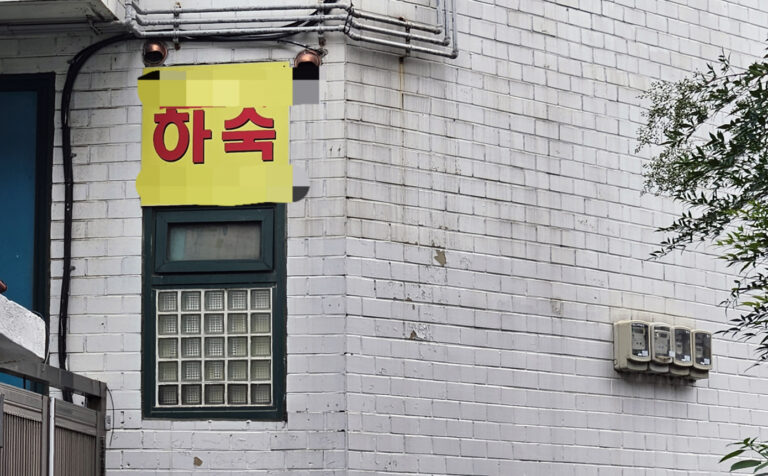
Hasuk

Hasuk business is one of the categories of the lodging business under the Korean Standard Industrial Classification (KSIC). However, it is not a type of lodging business subject to the Public Health Control Act, the Tourism Promotion Act, the Agricultural and Fishing Villages Improvement Act, or the Special Act on the Safety Management of Publicly Used Establishments, nor is there any separate statute specifically governing hasuk business. Nevertheless, it is clear that hasuk business falls within the scope of lodging business subject to value-added tax.
Dictionary Definition
As a lodging establishment, a hasuk is not significantly different from a yeoinsuk in terms of function, nature, or structure, except that it is generally less expensive. Initially, hasuk houses emerged in ordinary private homes near schools when spare rooms were available, or when rural students stayed in the homes of friends attending the same school. Over time, professionally operated hasuk houses displaying signboards began to appear in areas with convenient transportation, and some facilities came to have as many as 20 rooms.
Statutory Definition
The term hasuk business refers to a business that, after providing the necessary facilities, accommodates five or more persons and charges lodging fees on a unit basis of one month or longer.
Lobin Commentary

The Encyclopedia of Korean Culture explains that hasuk, as a lodging establishment, does not differ substantially from a yeoinsuk in terms of function, nature, or structure, and that the primary difference lies in lower costs. Of course, many yeoinsuks that still exist today operate on a short-term or daily basis. However, when viewed in light of the KSIC definition, hasuk appears to differ in that it provides meals in addition to accommodation.

Under the Korean Standard Industrial Classification, the other miscellaneous lodging businesses are defined as follows. Hasuk business falling under this category is not subject to the Public Health Control Act, the Tourism Promotion Act, the Agricultural and Fishing Villages Improvement Act, or the Special Act on the Safety Management of Publicly Used Establishments, nor is there any separate governing statute.

Other miscellaneous lodging business: Industrial activities that operate hasuk businesses, which provide both meals and accommodation together for an agreed period, or other lodging facilities not elsewhere classified.

The scope of lodging was defined in the Lodging Business Act Article 2 as below, but in the 1981 amendment, hasuk business was excluded from the scope of the lodging businesses pursuant to the Lodging Business Act, and in 1986 the Lodging Business Act was replaced by the Public Health Act.

  1. Under this Act, “lodging business” means hotel business, yeogwan business, yeoinsuk business, and hasuk business.
  2. “Hotel business” means a business that provides high-grade facilities of Korean-style or Western-style structure and equipment and accommodates persons in return for lodging fees.
  3. “Yeogwan business” means a business that provides ordinary facilities of Korean-style or Western-style structure and equipment and accommodates persons in return for lodging fees.
  4. “Yeoinsuk business” means a business that provides facilities and equipment in which lodging spaces are mainly shared by multiple persons and accommodates persons in return for lodging fees.
  5. Hasuk business” means a business that, after providing the necessary facilities, accommodates five or more persons and charges lodging fees on a unit basis of one month or longer.
  6. “Lodging” means the use of the facilities set forth in the preceding provisions with bedding.

At the time, Article 4 of the Enforcement Rules of the Lodging Business Act prescribed the following facility standards for hasuk businesses:

  1. Ventilation, lighting, illumination, and moisture-proof facilities must be fully provided.
  2. An appropriate number of toilets must be installed, windows and doors must be fitted with insect screens and moisture-proof facilities, and cleanliness must be maintained at all times.

Meanwhile, according to an official interpretation concerning hasuk business, it is clear that hasuk business constitutes a lodging business subject to value-added tax.

VAT Applicability to Hasuk Business (Ruling No. BuGa 46015-1957-1)

Where a hasuk business is operated independently as a business, providing both meals and accommodation to specified persons for an agreed fixed period, such hasuk business constitutes a lodging business under Article 2(1)2 of the Enforcement Decree of the Value-Added Tax Act and is therefore subject to value-added tax. In addition, where business assets used for such lodging business are transferred, value-added tax shall also be imposed.

Related Terms
Scroll to Top
Step 1 of 2

Access Request for Data Dashboard 2024

Data Dashboard 2024 provides detailed data for 17 metro markets by establishment type, visualized through Microsoft Power BI.

※ You can use Data Dashboard without extra charges before expiration of the existing access period, if 2025 data is updated during the access period.

Data Source

  • GDP: GDP, Current $US (World Bank Open Data)
  • Establishments: Compendium of Tourism Statistics (UNWTO), Lodging Business Ledger (MOIS)
  • Rooms: Compendium of Tourism Statistics (UNWTO), Lodging Business Ledger (MOIS)
  • Lodging GDP: Value Added by Industry (BEA), National Accounts (Cabinet Office), GDP of Indonesia (BPS), GDP & GNI by Sector (BOK), Economic Census (KOSIS)
  • Period: 2017-2021

※ In Korea, general & residential accommodations are included while rural & urban minbaks are excluded. Comparable countries are selected based upon availability of lodging GDP statistics for all types of accommodations.

Data Source

  • Population: Population, Total (World Bank Open Data)
  • GDP: GDP, Current $US (World Bank Open Data)
  • Rooms: Compendium of Tourism Statistics (UNWTO), Lodging Business Ledger (MOIS)
  • Lodging GDP: Value Added by Industry (BEA), National Accounts (Cabinet Office), GDP of Indonesia (BPS), GDP & GNI by Sector (BOK), Economic Census (KOSIS)
  • Period: 2017-2021

※ In Korea, general & residential accommodations are included while rural & urban minbaks are excluded. Comparable countries are selected based upon availability of lodging GDP statistics for all types of accommodations.

Coming soon! We're still in process.

1:1 Contact

※ Messages intended for defamation or obstruction of business by Lobin Co. and /or other third parties, or containing content that is obscene, violent or unrelated to Lobin Co.’s business, will automatically be blocked by the system and not delivered to the administrator.

Data Source

  • Korea: Lodging Business Ledger (MOIS), Tourist Accommodation Ledger (MCST)
  • USA: Census Database (STR)
  • Period: As at the end of 2021

※ General & residential accommodations other than rural and urban minbaks asre included for Korea. Life cycle was calculated as of December 31, 2021 or actual closure date. If there exists a discrepancy between data sources for an establishment, the discrepancy was settled through an algorithm before use.

Data Source

  • Korea: Lodging Business Ledger (MOIS), Tourist Accommodation Ledger (MCST), Economic Census (KOSIS), Hotel Operating Statistics (KHA), DART (FSS), Trends Report (STR)
  • USA: Compendium of Tourism Statistics (UNWTO), Census Database (STR), Trends Report (STR)
  • Period: 2005-2021

※ General & residential accommodations other than rural and urban minbaks asre included for Korea. Visibility was calculated as the number of establishments for which revenue data is available divided by the total number of establishments. If there exists a discrepancy between data sources for an establishment, the discrepancy was settled through an algorithm before use.

Data Source

  • Guests(Korea): Domestic Traveler Survey (MCST), International Traveler Survey (MCST), Hotel Operating Statistics (KHA)
  • Rooms(Korea): Lodging Business Ledger (MOIS), Tourist Accommodation Ledger (MCST)
  • Guests(USA): Compendium of Tourism Statistics (UNWTO), Trends Report (STR)
  • Rooms(USA): Compendium of Tourism Statistics (UNWTO), Census Database (STR)
  • Period: 2005-2020

※ General & residential accommodations other than rural and urban minbaks asre included for Korea. If there exists a discrepancy between data sources for an establishment, the discrepancy was settled through an algorithm before use.